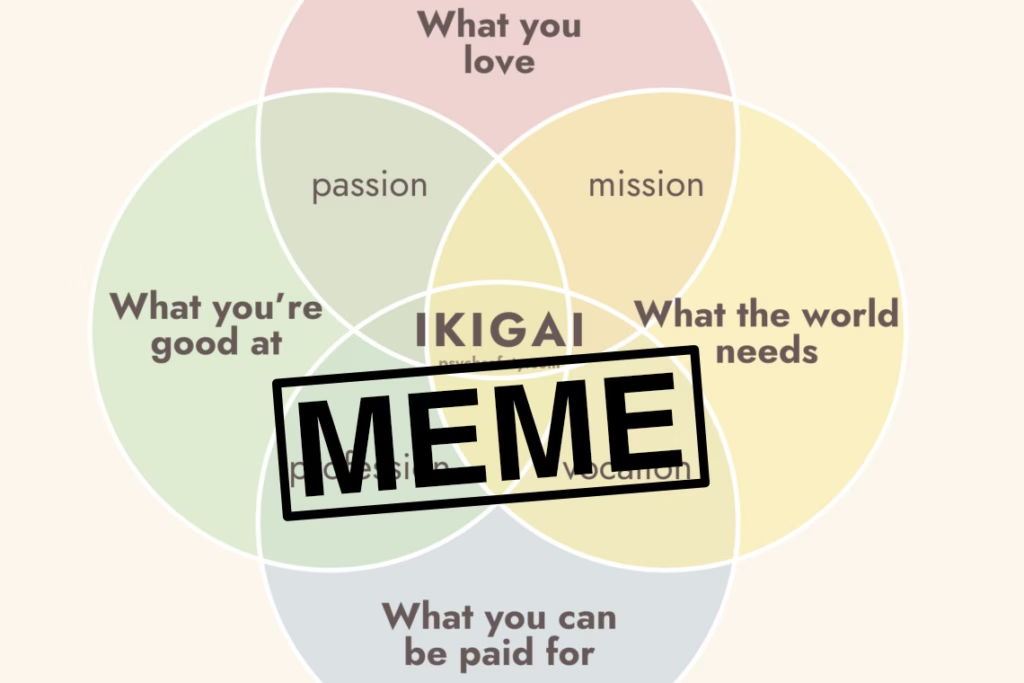
The well-known Ikigai diagram with four overlapping circles has become a staple of workshops, coaching decks, and LinkedIn posts. It looks wise. It sounds profound. But it has nothing to do with Japan and very little to do with what research actually says about purpose, motivation, or a long life.
I liked the book Ikigai and recommended it too easily. Then I started digging. Here is what I found and what it means for teams that want both strong performance and genuine well-being.
Four Circles, No Research
The famous four circles were never tested with Japanese people. They do not come from research. In Japan, hardly anyone knew the diagram before it came back as a Western invention.
In 2011, the Spanish astrologer Andres Zuzunaga created a “Purpose” diagram. There was no reference to Japan. Three years later, the British blogger Marc Winn watched a TED talk about life expectancy in Okinawa. He liked the word “ikigai” and replaced purpose with ikigai on Zuzunaga’s graphic. That version went viral. A book author picked it up. Now much of the world assumes that this is what ikigai means.
Japanese speakers usually do not recognize the diagram. That is the problem. People go looking for happiness at the intersection of four circles, but those circles were never about meaning, purpose, or Japan in the first place.
Where Ikigai Really Comes From
The real story starts with the Japanese psychiatrist Mieko Kamiya. In the 1950s, she made seven visits to Nagashima Aiseien, Japan’s largest leprosarium. About 1,700 patients lived there in isolation.
Kamiya conducted psychiatric interviews and questionnaires. She wanted to understand one thing. Why did some patients with mild symptoms describe their lives as meaningless, while others with severe and disfiguring illness still felt their lives were deeply worth living?
That question became her life’s work. In 1966, she published Ikigai-ni-Tsuite (“On the Meaning of Life”).
Kamiya argued that the feeling of ikigai, which she called ikigai-kan, depends on a cluster of needs. Think of life affirmation, freedom, future orientation, and self-realization. Not everyone needs all of them. No single combination was universal. But several needs kept showing up, even in people living under severe constraints.
Notice what is missing: money, career, and what the world needs in any market sense. Very few leprosy patients had those things. Yet they still had ikigai in the original sense. That is also how I use the term in the rest of this article.
Nine Questions Instead of Four Circles
Kamiya’s clinical theory was later turned into something measurable: the Ikigai-9, a nine-item questionnaire developed and validated by Imai, Osada, and Nishimura in 2012. It was later tested in the UK, Germany, and France.
The Ikigai-9 measures roughly three dimensions:
- the feeling that life has meaning
- the feeling that you are needed
- the feeling that you can grow
Answers are scored on a scale from 9 to 45. Nothing like four circles.
One Simple Question About Longevity
The longevity studies did not even use all nine items. They asked one direct question about whether people felt a sense of meaning in their lives.
The Ohsaki Study (Sone et al., 2008) followed 43,391 Japanese adults for seven years. The question was simple: “Do you have ikigai in your life?” People who answered no had a 50% higher risk of dying during the study period. The increased risk was mainly linked to cardiovascular disease and external causes, not cancer.
The Japan Collaborative Cohort Study followed participants for more than ten years. People reporting ikigai had roughly 7 to 15 percent lower all-cause mortality. In men, the effect was especially visible in lower cardiovascular mortality.
These are large, well-designed cohort studies. They are not anecdotes from a productivity blog. They show that people with ikigai die less often. They do not prove that you can lower someone’s mortality risk by somehow “installing” ikigai. Almost all of this research comes from Japan, so we do not know how well it travels. Scientific honesty matters more here than a neat story.
Motivation and Well-Being Through Self-Determination
As a coach, I use a different framework: Self-Determination Theory (SDT) by Deci and Ryan. It rests on fifty years of cross-cultural research. That evidence base is much larger than anything behind the ikigai meme.
SDT proposes three universal psychological needs that drive real motivation and well-being:
Autonomy: your actions feel chosen rather than forced. That is not the same as being independent. You can freely choose to serve a team goal and still experience autonomy.
Competence: you feel effective and able to grow in meaningful work.
Relatedness: you feel connected to and supported by others.
Unlike the ikigai literature, SDT has been tested explicitly across cultures. Studies in Western Europe and East Asia, including Japan, Hong Kong, South Korea, and China, show that autonomy and relatedness matter in both. People in collectivist cultures also experience autonomy when they choose to act for the good of the group. The key is that the choice feels like theirs.
Where SDT is thinner than ikigai research is simple: it has not yet been tested against hard mortality data in the way the Ohsaki studies tested ikigai.
What This Means for Your Team
This is where it becomes practical. This is also where performance and well-being start to line up.
Autonomy means engineers making technical choices instead of just executing specs. It means marketers having real room to shape a campaign, not just waiting for approval on channel and copy. Autonomy-supportive environments create stronger motivation. That also holds under tight deadlines and high accountability. Boundaries do not undermine autonomy when people understand why those boundaries exist.
Competence means stretch with support. The work has to be hard enough to help people grow. It also needs fast, concrete feedback. That is how people improve. Teams that overprotect people, or throw them in at the deep end without feedback, fail to support the need for competence.
Relatedness means psychological safety and genuine collegial connection. Not forced fun. Not another team outing. Relatedness is the experience of being supported rather than merely sitting next to each other. The ikigai research puts strong emphasis on this dimension. That is a useful correction to Western coaching, which can lean too heavily on individual autonomy and invest too little in belonging.
Meaning and purpose mean a credible, felt answer to the question: “Why does my work matter?” Not a poster on the wall. Closer to Kamiya’s insight that meaning can survive even under hard conditions, as long as an important need is being met. In a team, that may be as simple as seeing the impact of the software they build or the campaign they run.
Some teams get these conditions right. Those teams experience more satisfaction at work, and they sustain stronger performance over time. Well-being and productivity go hand in hand.
If you would like to explore how needs and long-term motivation can drift apart, read balancing needs and shoulds.
Give Ikigai. Don’t Tick Four Boxes.
The four-circle diagram is a nice story with no scientific foundation. What the research actually supports is more specific and more testable: build environments with real autonomy, real growth paths for competence, and strong relatedness.
But the most essential insight is this: ikigai is not something you get by ticking four boxes. It is something you can give.
You can help people feel that they matter. You can help them feel needed and important to others. Who will you give ikigai to today?
Practice With Your Team
If you do not just want to read about this, but practice it with your team, the Agile Leadership Training helps you work on autonomy, competence, and relatedness in a concrete way, in your own situation.
If you want to find answers to your questions about purpose and motivation, take a look at Socratic Coaching.